
Video Is Not a Nice-to-Have. It Is the Trust Infrastructure.
There is a version of this conversation where we talk about LinkedIn video as a marketing tactic. A content strategy. A way to stay visible.
That framing undersells it.
In a business that runs on trust — where a client is handing you responsibility for their financial future, their retirement, the wealth they have spent a lifetime building — the question they are asking before they ever pick up the phone is not ‘Is this firm competent?’ It is ‘Can I trust these people?’
Video answers that question faster than any other medium. Faster than a website. Faster than a brochure. Faster than a LinkedIn text post. Because video shows a person. It shows how they think, how they communicate, whether they are the kind of adviser who speaks plainly or hides behind jargon. It shows humanity. And humanity is what trust is built from.
For a wealth management firm in 2026, video on LinkedIn is not optional. It is the core of your trust infrastructure.
The Most Common Mistake: Making It About You
Most LinkedIn video content from financial professionals falls into the same trap.
It is me-centric.
‘Here is our firm’s history.’ ‘Here is our investment philosophy.’ ‘Here is what we did last quarter.’ ‘Here is a graph of market performance.’
The person watching does not care about any of that — yet. Not until they feel understood. Not until the content has earned their attention by showing them that you get what they are dealing with.
The question every viewer asks in the first three seconds of any video is: is this for me? If the answer is not immediately obvious, they scroll.
The fix is straightforward. Before you write a word of a script, ask: what is the one thing my ideal client is worried about right now that I could help them think through? Start there. Answer that question. Then — and only then — does your methodology become relevant.
There is also a specific habit worth breaking in a numbers-driven industry. Wealth managers often default to graphs, charts, and data — because that is how they process information. But many of their clients do not. The most effective financial videos translate data into human outcomes. Not ‘the FTSE returned 8.3% this year,’ but ‘what that kind of return means for a 57-year-old who wants to retire at 62.’ The outcome. The consequence. The story behind the numbers.
On Production Value: Humanity Beats Cinema Every Time
There is a temptation, particularly in a high-trust, high-fee industry, to invest heavily in production. Professional crew, studio lighting, broadcast-quality cameras.
I have spent 28 years as a lighting cameraman in UK broadcast television. I understand the instinct.
But here is what I have also learned from that career: the most expensive kit in the world cannot compensate for a presenter who is uncomfortable. And the most common reason a wealth manager looks wooden on camera is not a lack of talent — it is being surrounded by production equipment and people they do not know, while trying to perform naturally.
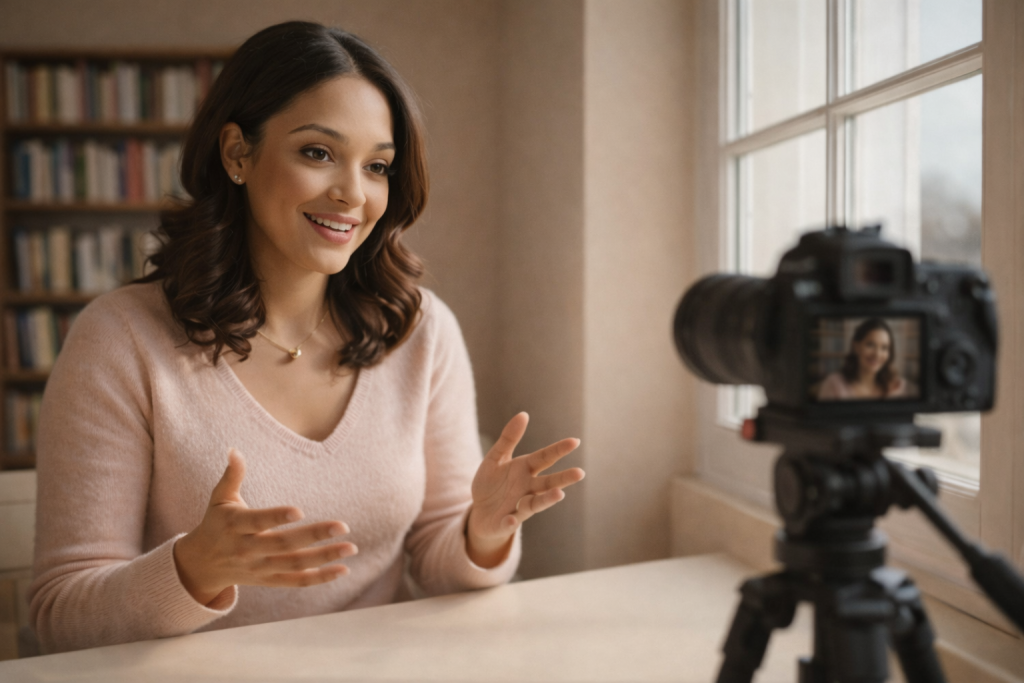
A well-lit smartphone video, filmed in a familiar space, where the person is relaxed and speaking as they would in a client meeting, will connect more effectively than a polished, over-produced piece that has drained the humanity out of the presenter.
The goal of the video is connection. Do not let production kit get in the way of that.
Start simple. Get the lighting right — a window to one side, or an inexpensive LED panel. Get the audio right — a clip-on lapel microphone costs very little and makes an enormous difference. And then just talk. Talk as you would to a client who is sitting across a desk from you, who is worried about something, and who needs you to help them think it through.
That is what trust-building video looks like. It does not require a crew.
Going Viral Is the Wrong Goal
LinkedIn will show you analytics. Views, impressions, engagement rates. The platform is designed to make those numbers feel important — because the more you focus on growing them, the more content you create, and the more content you create, the more inventory LinkedIn has to serve advertisements against.
The analytics LinkedIn shows you are designed to serve LinkedIn’s business, not yours.
Going viral means getting your content in front of millions of people. For a consumer brand selling a product at scale, that has value. For a wealth management firm that needs five new clients a year — or ten, or twenty — it is largely irrelevant.
Think about the maths. If your video gets 50 views, and those 50 views are the 50 people in your local professional network who are at exactly the right life stage, with exactly the right level of assets, at exactly the right moment of thinking about their financial future — that is a far more valuable 50 views than 50,000 views from people who have no connection to what you do.
Reverse-engineer from the outcome you actually want. How many new clients do you need this year? How many conversations does that typically require? How many of those conversations start from someone who has seen your content? Now you know what success actually looks like on LinkedIn — and it has nothing to do with virality.
Track the conversations that start off-platform. Track the referral introductions where the introducer mentions they have been watching you. Track the enquiry calls that open with ‘I have been following you for a while.’ Those are your metrics. LinkedIn analytics will not show them to you. You have to record them yourself.
What Consistency Actually Looks Like: Nicky’s Story
Nicky Kildunne runs development work for the FSB — the Federation of Small Businesses — and has been publishing short video updates on LinkedIn every week for years.
The videos are not complicated. They are two-minute news updates. What is happening in the FSB world, what is relevant for small business owners this week, what support is available. Filmed simply. Published consistently.
The results have been straightforward and compounding. Each video reaches around 200 individual viewers and generates between 700 and 1,000 impressions — consistently outperforming every static post she publishes. But the more important number is this: she can now produce each video in under an hour.
And the impact has gone beyond the analytics. People come up to her at events having never met her in person, and they already feel they know her. Stakeholders she features in videos feel valued. Membership enquiries have grown — not from a campaign, not from an ad, but from the slow accumulation of a presence that says, week after week: I am here, I understand this world, and I am consistently showing up for the people in it.
That is what trust-building on LinkedIn looks like. It is not dramatic. It does not go viral. It just keeps going.
The Practical Starting Point
If you are a wealth manager or IFA who has been hesitating on video, here is the simplest possible starting point.
Write down the five questions your clients ask you most often in an initial meeting. Each one of those questions is a video. Film them on your phone, in your office, with a window to your left or right. Keep each one under three minutes. Publish one a week.
Do not worry about production quality beyond lighting and audio. Do not worry about view counts. Do not chase the algorithm.
Just show up. Answer the questions. Keep going.
The trust builds in the watching. And the watching happens over months, not days. A prospect who finds your first video today may watch twelve more before they ever send you a message. By the time they do, they already trust you. The sales conversation has already happened — on their own terms, in their own time, through your content.
That is the real value of video for a wealth management firm. Not reach. Not virality. The quiet, compounding accumulation of trust with exactly the right people.
Summary
Video on LinkedIn is not fluffy marketing. It is the mechanism through which high-trust, high-value service businesses build the relationships that generate long-term clients.
You do not need a production crew. You do not need to go viral. You do not need to be entertaining.
You need to show up, week after week, as the knowledgeable and human professional you already are — and let the right people find you, watch you, and decide, in their own time, that you are the person they want to work with.
That decision does not happen in one video. It happens across seven hours of content, on multiple platforms, over months.
The only way to accumulate those hours is to start.
